
[ad_1]
8 minute read time

When Amanda Natividad started her newsletter, the VP of marketing at SparkToro and classically trained chef focused mostly on the craft of creating a strong newsletter. Six months in, she had a repeatable format she was comfortable with, a steady cadence…and only 400 followers.
All her hard work deserved a bigger audience. Amanda turned to her considerable marketing experience and created a newsletter growth plan. She reached 1,000 subscribers a month and a half later.
Today, she has 2,600 readers and gains around 500 more each month. Here’s the method that helped Amanda gain 600 new subscribers in six weeks — and can help you, too.
Plan a sustainable format
Consistency is essential to building a successful newsletter. Before you write your first email, decide what you want to send and how often. The most important thing is finding a schedule you can stick to.
It might take some time to figure out what works. If the format you chose is causing you stress, keep iterating until you find one you can stick to. Swap out a section you never have enough content for in favor of something more flexible or send less often than you initially intended.
[I]f you aren’t sure whether you’ve found your groove, keep testing new things.
“And if you aren’t sure whether you’ve found your groove, keep testing new things,” Amanda advises. “Not just new ideas, but test your schedule, writing cadence, try seeing if publishing ahead of time begets new ideas for a newsletter.”
Amanda’s newsletter has been through multiple changes since it launched. “I knew from the very beginning I wanted to have some curation element,” she said. But it took her a while to land on the name Petits Fours and the four-link format. At one point, she included screenshot interviews in each issue but dropped them because they took too much time. She can try new things without losing followers because she’s consistent in delivering high-quality, topical information.
Get an initial audience through existing networks
Your network can help you get your email list started, but you’ll need access to a bigger audience to continue growing. Even with word-of-mouth support from her initial subscribers, Amanda was limited in how many people she could reach. Her subscriber count started rising again when she looked to built-in social media audiences.
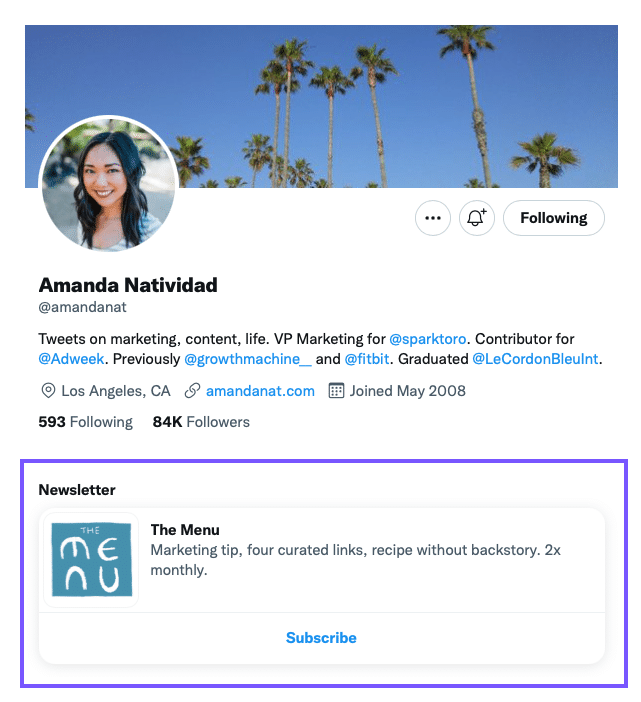
Amanda promoting her newsletter on Twitter.
She used her social media presence — largely on Twitter — to drum up interest for her newsletter. If you don’t have a lot of followers, reply to big accounts with fresh insights or funny observations. Follow up every attention-getting post with a plug for your newsletter. Twitter hashtag discussions can help you get traffic and earn new followers. Amanda also joined writing communities on and off Twitter to find support and subscribers.
Use early subscribers as beta testers
Your relationship with your audience shouldn’t be one-sided. Amanda A/B tested headlines and tracked link clicks to refine her content. The main metric she focused on was the open rate, which she got up to 60%. For reference, our latest benchmarking report found the average email open rate is 21.5%.
Amanda also solicited feedback by asking her subscribers questions. In fact, she still does “when it feels organic.” Only a small percentage of subscribers reply, but their comments can be invaluable. Sometimes, readers will respond without prompting if they have strong feelings about something: “One time, I skipped the recipe and instead offered a food tip, and 2 people replied to say they were bummed I didn’t send a recipe,” Amanda says. She’s doubled down on including recipes since then.
More people are rooting for you than you think.
The one thing Amanda wishes she’d tested was sending a shorter newsletter. “Sometimes I wonder if my newsletter is too long, but it might be strange to renege on length now that I have a few thousand subscribers,” she told us. However, her top takeaway had nothing to do with her content, scheduling, or newsletter logistics. “[The] biggest thing I learned is, truly, the importance of creating a safe space for yourself to test ideas,” Amanda said. “More people are rooting for you than you think.”
Incentivize signups (and make them easy)
Even engaged followers are unlikely to take your word that they should sign up for your newsletter. Amanda offered value with signup magnets. She didn’t go the traditional route of giving a downloadable resource to anyone who shared their email. She told her Twitter followers they’d get her recipe for Bulgogi Shepherd’s Pie if they signed up before she sent her next email. Seventy of them joined that day. It wasn’t an offer she could use more than once, but it did provide a sense of urgency.
For subscribers who don’t see the incentives she tweets, Amanda shows exactly what her newsletter provides. Her website, amandanat.com, has copies of every newsletter she’s sent. Offer free previews, so readers can see what they’re signing up for before committing.
The easier your signup form is to complete, the more subscribers you’ll get. Amanda sends emails through Revue, which is owned by Twitter. As a Twitter user, she loves how anyone who finds her on Twitter can sign up for her newsletter with one click.
Elements of a good newsletter signup page
How can your signup page reduce risk and make it easy for new readers to subscribe? Here’s what Amanda Natividad recommends:
- Set expectations: Tell a reader exactly what they’ll get when they share their email and offer sample content for them to view before signing up.
- Prove credibility: Amanda mentions her culinary school training and tech/marketing work to show she knows what she’s talking about.
- Provide social proof: Share the size of your email list or reviews to prove your subscribers are benefitting from your newsletter.
Create opportunities to promote yourself
Reach beyond your audience by appearing on podcasts, writing guest posts, or contributing to other credible media within your niche. Choose promotional efforts that benefit you and another creator in your niche for the biggest effects.
Every external marketing opportunity needs to have a double purpose or else I can’t commit.
The size of your audience and the amount of time you have to spend on promoting yourself will shape the types of opportunities you should look for. Here are Amanda’s recommended methods:
- Co-marketing: Use your newsletter to recommend and link to other newsletters in the same subject area. You’ll likely get a shoutout in return, especially if you know the writer.
- Podcast appearances: Reach out to podcasters to see if they’re looking for guests and tell them you’ll cross-promote your episode to your email list. Then mention your newsletter during recording.
- Guest posts: Reach out to bloggers or newsletter writers and offer to contribute a guest post. Make sure your name is prominently attached, and add a link to your newsletter.
- Webinars: Partner with a friend to host a webinar. After you’ve won over attendees with your expertise, mention your newsletter and invite them to subscribe.
Cross-promotional opportunities can also help you come up with ideas for your own newsletter. Write an entire issue about something you discussed on a podcast, or add an excerpt from your guest post to your next newsletter.
Amanda now considers how opportunities can boost her personal brand or that of SparkToro, where she currently works. “Every external marketing opportunity (like a podcast or webinar) needs to have a double purpose (say, to promote SparkToro AND serve as inspiration for a Twitter thread for my personal account) or else I can’t commit,” she says.
Be careful not to stretch yourself too thin. Amanda learned the hard way that taking every opportunity means losing time she’d like to spend on other pursuits. She advises writers to “block times on your calendar for serendipitous opportunities (like potential podcast appearances), and STICK TO IT.” While too many opportunities may sound like a good problem to have, you don’t want your newsletter (or other commitments) to suffer because you’re too busy.
Anyone can start a successful newsletter
Everything Amanda did is replicable if you’re willing to put in the work. You will see a return on investment for the effort you expend to promote yourself and your newsletter.
The most valuable thing you can give your newsletter is time. “I spend maybe 2 hours on each newsletter edition, the day of the send. The fastest I’ve been able to do this is just over 1 hour,” Amanda shared.
She’s also constantly thinking about how to improve her emails. “Now that you ask me, I might always be testing a new section. You might see me experimenting with new ways to promote my YouTube show in the near future,” she told us.
You can see her new efforts for yourself by subscribing to The Menu or following her on Twitter at @amandanat.
[ad_2]
Source link



More Stories
Unlocking Hidden Value: How Financial Services Companies Are Redefining Wealth in the Digital Age
Unlocking Hidden Gains: How Top Investment Companies Turn Risk Into Reward
The Hidden Costs of Finance Companies: Why Borrowers Often Pay More Than They Bargain For